 WIKI
WIKIA card game with friends.
Your code. Your duel.
Wiki Battle is a free card game with friends that runs in any modern browser, on a phone or a desktop. Create a private room, send the six-character code, and each of you brings three cards from your own collection of real Wikipedia subjects. Three rounds, 60 seconds each, and neither player sees the other’s move until both are locked in.
What you need for a card game with friends
Two players, two browsers and a few minutes. There is nothing to install and no deck to buy: every new collector opens 3 free packs, 15 cards in total, so even a friend who joined five minutes ago can build a legal deck of three different cards. Distance does not matter either; a classmate down the hall and a cousin abroad join in exactly the same way.
Each player needs their own identity. A guest collection lives in a browser cookie, so two people sharing one laptop should use two browser profiles. Signing in with email or Google keeps your cards safe if you clear cookies and lets you continue on another device.
Set up a private room
- Open Battle and choose Create room. The game shows a six-character code and an invitation link you can paste into any chat app.
- Your friend opens the link, or types the code and presses Join room. Codes ignore letter case and skip look-alike characters such as I, O, 0 and 1, so they are easy to read out loud.
- Both players pick three different cards they own and press Ready up. Your friend can see that you are ready, but not which cards you chose.
- The second Ready up starts the duel at once. To change your deck before that, withdraw your ready state and choose again.
A room has exactly two seats and waits ten minutes for both players. The host can close it, and the guest can leave before the match begins. If a chosen card leaves your collection through a trade or a fusion in the meantime, you have to pick a replacement before the duel can start.
How each round works
Every round runs on a 60-second server clock. Both players secretly choose an unused card and a stance, and the two moves are revealed together, so clicking first gives no advantage. The stances form a triangle: Attack beats Feint, Feint beats Guard and Guard beats Attack.
| Matchup | Your damage | Their damage |
|---|---|---|
| Your stance wins the triangle | 90% | 40% |
| Attack against Attack | 100% | 100% |
| Feint against Feint | 70% | 70% |
| Guard against Guard | 30% | 30% |
Base damage is the attacker’s ATK scaled down by the defender’s DEF. A card that uses its theme’s favourite stance deals 10% more (Wildlife and Space with Attack, Landmarks and Nature with Guard, People and Artifacts with Feint), and a correct answer to the round’s knowledge strike adds 20%. Starting health is 70% of your three cards’ average HP after any formation bonus. A knockout ends the match early; otherwise the higher remaining health after three rounds wins, and equal health is a draw.
Example: a card game with friends, round by round
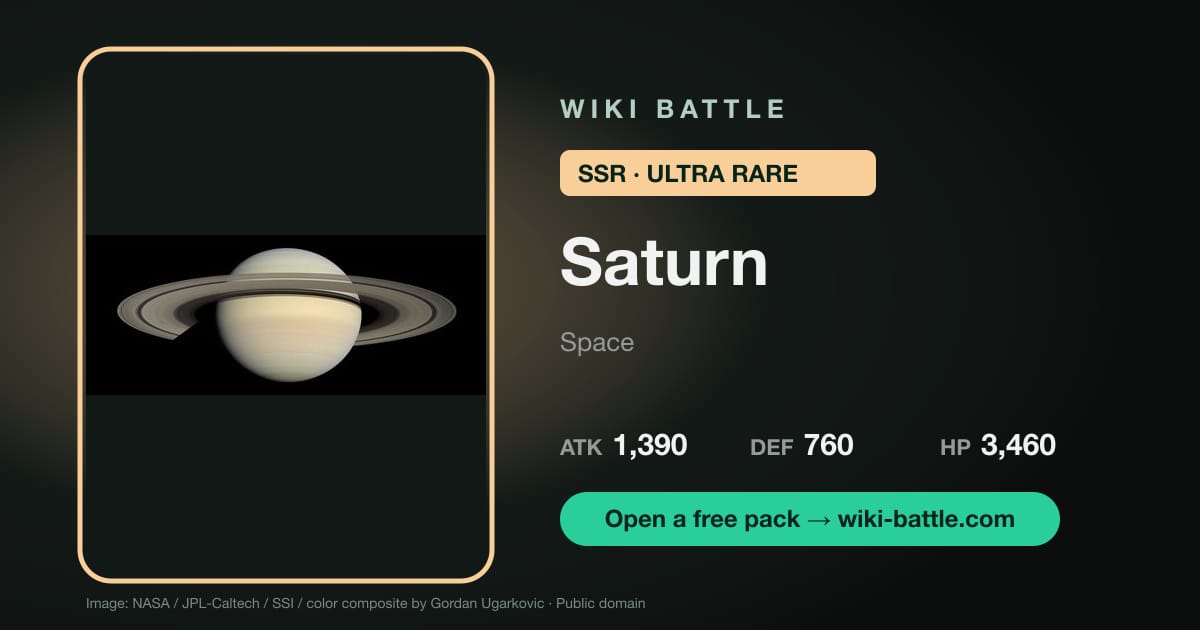
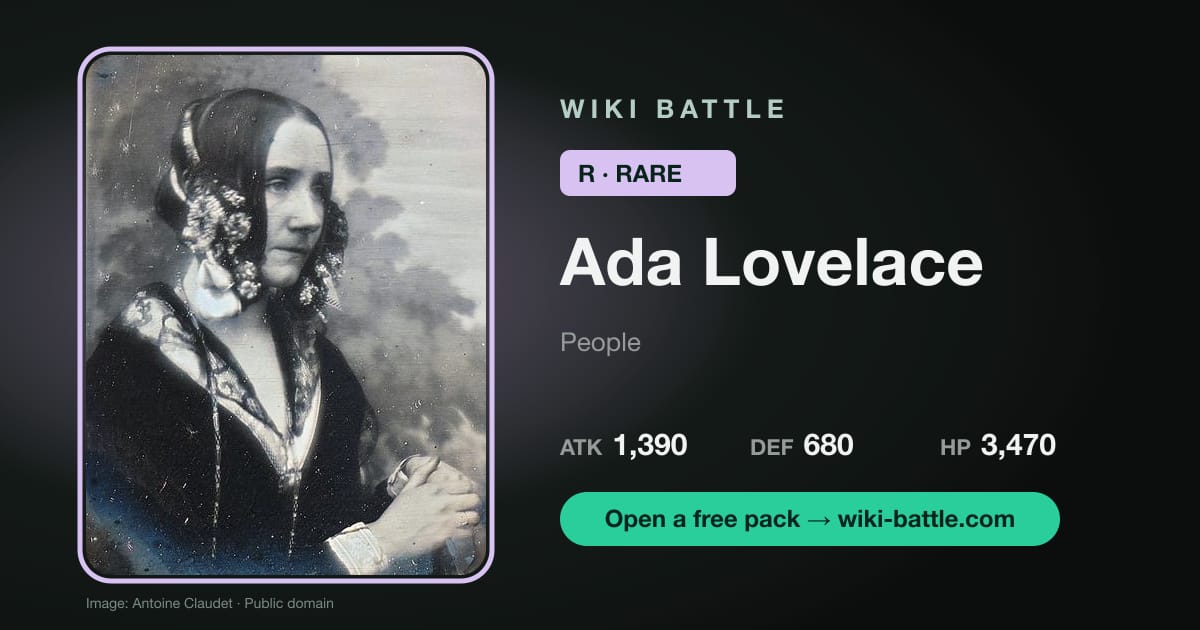
Here is a real calculation with the current card stats. You bring Saturn, Titan and Enceladus, which completes the Saturn and its moons formation for +10% ATK, DEF and HP. Your friend answers with Ada Lovelace, Analytical engine and Alan Turing, completing The computing pioneers. You start on 2,685 health and your friend on 2,659.
| Round | Your move | Friend’s move | You deal | You take | Health after |
|---|---|---|---|---|---|
| 1 | Saturn · Attack + correct answer | Ada Lovelace · Feint | 1,039 | 366 | 2,319 vs 1,620 |
| 2 | Titan · Attack | Analytical engine · Guard + correct answer | 396 | 807 | 1,512 vs 1,224 |
| 3 | Enceladus · Feint + correct answer | Alan Turing · Guard + correct answer | 828 | 412 | 1,100 vs 396 |
In round 1 your Attack beats Feint and the knowledge bonus lands on top. In round 2 your friend expects a second Attack from a Space card and blocks it with Guard, taking the round. In round 3 you switch to Feint, which beats Guard even without the Space affinity, and the match ends 1,100 to 396 in your favour. The duel was decided by reading habits, not by rarity.
Strategy for a rematch
In any card game with friends, the second match is different from the first, because your rival now knows your habits. A few habits of your own help:
- Vary your stances. Every theme’s favourite stance is public, so a friend who sees Space or Wildlife cards will expect Attack and may answer with Guard.
- Plan the order. Each card plays exactly once, so decide early which round gets your highest ATK.
- Protect a lead. Guard against Guard deals only 30% each way, which limits the swing when you are ahead before the last round, unless your friend sees it coming and Feints.
- Always answer. Only a correct knowledge strike changes the damage and a miss carries no penalty, so even a guess is free.
- Use formations. A full themed trio adds +6% ATK, DEF and HP, and a listed story adds +10%. Browse the team formations before you save a deck.
More ways to play with friends
Room codes are the quickest route to a card game with friends, but a whole social layer sits around them:
- Friend challenges. Add someone with their collector code, then challenge them directly. Incoming challenges appear under the invitation bell and expire after ten minutes if nobody answers.
- Messages and guilds. Accepted friends can message each other, and a guild holds up to 20 collectors with its own chat.
- Trades and auctions. Swap cards with a friend or bid with earned coins, then compare collections and arena ratings on the leaderboards.
- Nearby. An opt-in list of players within roughly 100 km. Locations are rounded to a 0.1-degree grid, shown only as broad distance bands and cleared after 24 hours.
Invite a friend, earn packs together
The easiest way to start a card game with friends is your personal invite link. A friend who opens it within 48 hours of their first visit, before opening more than 5 packs, gets 1 bonus pack straight away. Once they have opened 3 packs, won a battle and played on 2 different days, you each receive 2 packs, for up to 5 friends a week.
Rewards, rating and fair play
Completed player duels pay 20 coins for a win, 10 for a draw and 5 for a finished loss, within a daily cap of 100 battle coins. Each human opponent pays out once per day, which keeps a card game with friends fair and stops anyone farming a willing partner. The first 5 battles each day also earn Atlas Pass XP, and room duels, friend challenges and nearby duels adjust an Elo rating that starts at 1,000. Forfeits, timeout losses and matches that end before any round earn nothing.
If a connection drops, reopen the same battle link in the same browser to recover your saved move; active matches also wait under Saved battles. The clock keeps running while you are away. If only one player commits before the deadline, that player wins on timeout, and if neither does, the match ends in a draw.
When your friend is offline
Practice against Archive Sentinel, a clearly labelled AI opponent. It leans toward its cards’ favourite stances, answers the knowledge strike correctly a little over half the time, has no round timer and never changes your rating, but it still pays coins and XP under the same daily limits. It is a good way to test a new deck before your next card game with friends.
Card game with friends FAQ
Is this card game with friends free?
Yes. Rooms, friend challenges and AI practice cost nothing. Every player starts with 3 free packs and receives another every 12 hours; optional pack bundles exist in the shop, but no purchase is needed to play a friend.
Can two people play on the same device?
Only with separate identities, because each collection belongs to one browser profile or one signed-in account. Use two browser profiles on a shared computer, or simply play from two phones.
Do we lose cards when we lose a battle?
No. Battles never stake or consume cards, and every card stays in its owner’s collection. The loser of a completed duel still earns 5 coins.
Can I play with friends in another country?
Yes. Room codes and friend challenges work anywhere with an internet connection. Only the optional nearby list is limited to roughly 100 km.
How many players fit in one room?
Two. Every room is a 1v1 duel with exactly two seats, so a larger group pairs off into separate rooms and compares results on the arena leaderboard.
New to the cards themselves? The Wikipedia card game overview explains packs, rarities and stats, and the rules page lists every formula.