How to play Wiki Battle.
A few simple rules.
This guide explains how to play Wiki Battle, a free browser game in which real Wikipedia subjects become collectible cards. Open packs, build a 180-card collection, fuse duplicates, win three-round duels and answer a short daily quiz. Every number below is read from the same rules the game uses.
How to play Wiki Battle in five steps
- Open your packs. You start with 3 packs, and a free one arrives every 12 hours, with up to 2 waiting.
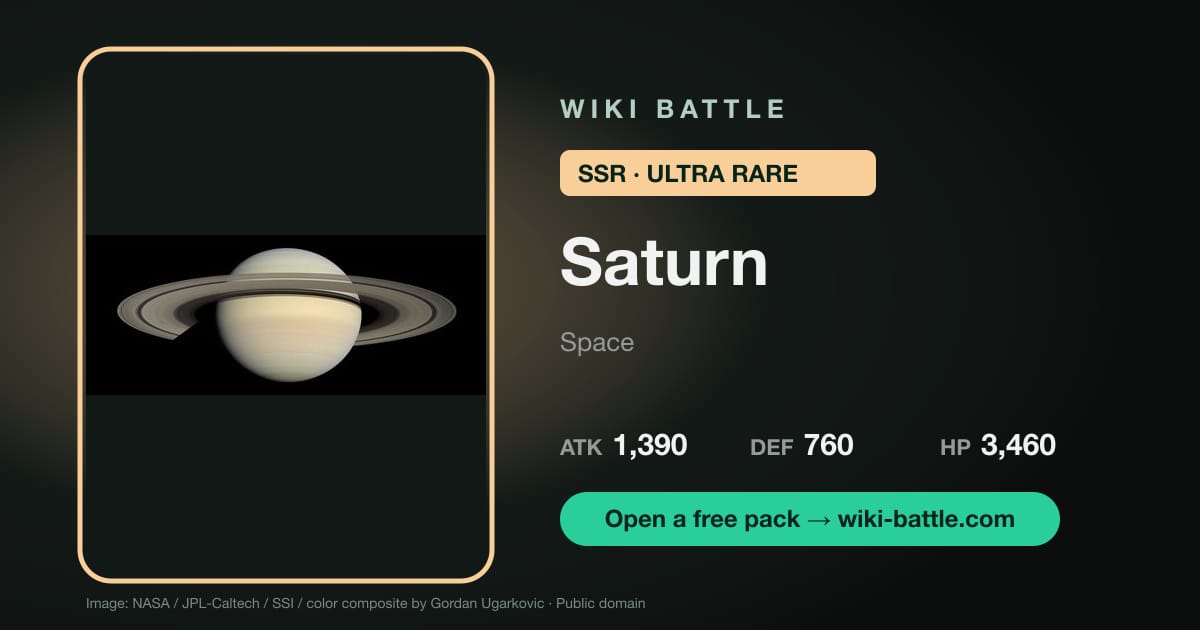
- Collect the cards. Each card is a person, artifact, landmark, natural wonder, animal or object in space, with stats measured from its English Wikipedia article.
- Use your duplicates. Craft a missing card, add a cosmetic finish or fuse five copies into the next rarity.
- Battle with three cards. Pick a card and a stance each round against the AI, a friend or a room code.
- Come back daily. The quiz, check-in and missions pay coins and season XP; 500 coins buy another pack.
Packs, rarities and odds
Packs are the core of how to play Wiki Battle. Each holds five different cards: slots one to four use the standard column below, while the featured fifth slot never drops below Rare. Cards are revealed from the lowest tier up and join your collection the moment the pack opens. Packs from rewards or coin exchanges never reduce the free allowance.
| Rarity | Slots 1–4 | Featured slot 5 | Craft cost |
|---|---|---|---|
| L · Legendary | 0.1% | 0.5% | 10 duplicates |
| SSR · Ultra Rare | 0.9% | 3.5% | 8 duplicates |
| SR · Super Rare | 5% | 16% | 6 duplicates |
| R · Rare | 16% | 80% | 5 duplicates |
| UC · Uncommon | 28% | — | 4 duplicates |
| C · Common | 50% | — | 4 duplicates |
Inside a rarity every card is equally likely, and repeats only happen across different packs. Pity is a hard ceiling: at most 9 packs in a row can pass without an SSR or Legendary, and at most 59 without a Legendary. One counter covers free, earned, coin and paid packs, and paid packs use exactly the same odds. Rarity is fixed once a card is released and never multiplies its stats.
Duplicates: crafting, finishes and fusion
Playing well means never wasting a spare copy. Under Fusion & crafting → Complete my collection, trade same-rarity duplicates for one specific missing card at the craft cost above; one copy of every card you own is always kept. Spare copies of one card can also buy a cosmetic finish: Silver for 2 extra copies, Gold for 3 more, Holo for 5 more. Finishes never change stats.
Fusion takes exactly five copies of one rarity, repeats allowed, and always returns one card of the next tier (C → UC → R → SR → SSR → L), drawn evenly from next-tier cards you do not own yet. Legendary cards cannot be fused, and fusion costs no coins. The lab protects your last copies, starred cards, saved-deck cards and mutated copies unless you switch protection off for a fusion, and fusions of Super Rare or higher, or with protected cards, need a one-second press-and-hold. A confirmed fusion is permanent.
Atlas Registry: serials and mutations
From Rare upward, each copy you obtain from a pack, fusion or craft receives its own serial number for that card, counted in mint order, plus a record of its first owner and every later owner. The first 100 serials of each card carry the First Edition mark. Every card from a pack, fusion or craft also gets one mutation roll; mutated copies are registered whatever their rarity.
| Mutation | Chance per card | Look |
|---|---|---|
| Prism | 2% | Rainbow light runs across the whole card. |
| Inverted | 0.7% | The artwork is printed in negative colours. |
| Gilded | 0.25% | Gold-leaf frame and gold ink. |
| Misprint | 0.05% | Off-register print with doubled ink — the rarest error. |
| Any mutation | 3% | About 14.1% of packs contain at least one |
Registered copies can be swapped or auctioned for earned coins along with their history, but they never change battle stats and have no cash value. Fusion, crafting and finishes spend unregistered copies first, then your highest serials; mutated copies are only used when you pick them. Copies from before the registry opened have no serial.
How to play Wiki Battle in the arena
Choose three different cards you own, then practise against the AI bot Archive Sentinel, challenge an accepted friend, or share a six-character room code. Each round, both players secretly commit an unused card and a stance: Attack, Guard or Feint. The stances form a triangle: Attack beats Feint, Guard beats Attack, and Feint beats Guard. The winning stance deals 90% damage and the losing one 40%; matching stances deal 100% (Attack), 70% (Feint) or 30% (Guard) each.
Base damage is your card’s ATK × 1,000 ÷ (1,000 + the rival card’s DEF), minimum 1. A card playing its theme’s favourite stance gains +10% damage: Attack suits Wildlife and Space, Guard suits Landmarks and Nature, Feint suits People and Artifacts. Each round both players also see the same knowledge-strike question, such as which article drew more readers; a correct answer adds 20% to that move. Each side begins with health equal to 70% of its three cards’ average HP, formation bonus included.
Moves stay hidden until both players commit. A knockout ends the duel early; otherwise more health after three rounds wins, and a tie is a draw. Cards are never consumed. Coin rewards for finished battles are 20 (win), 10 (draw) and 5 (loss), capped at 100 per UTC day and paid once a day per human rival; forfeits and timeouts earn nothing. Your first 5 battles each day earn season XP, and player duels adjust an Elo rating starting at 1,000, while AI practice is unrated.
Formations and saved decks
Formations are the deepest part of the game. A deck with two different cards from the same theme gains +3% attack and defense, and one with all three from a single theme gains +6% attack, defense and health. A complete listed family or story of three cards adds +10% to every stat. Only the strongest formation applies, and the AI follows the same rules. Suggest a team compares themed lineups with your strongest mixed deck, and you can save three decks. The formation directory lists every eligible card and story.
Friends, rooms and nearby players
Player duels allow 60 seconds per round; if only one player commits, the other loses on timeout, and if neither does, it is a draw. Rooms and invitations expire after ten minutes. Nearby discovery is optional and shows other opted-in players only as broad distance bands. The multiplayer guide covers rooms step by step.
How to play Wiki Battle every day
Everyone gets the same three quiz questions each UTC day, with a fresh set at 00:00 UTC, and answers lock when submitted. Finishing all three pays 40 coins and 40 season XP, plus 10 coins for at least two correct answers. The quiz is separate from knowledge strikes in duels.
Daily rewards add a 30-coin check-in and 4 missions (open a pack, finish 2 battles, win a battle, share a discovery) worth 20–25 coins plus season XP each. Playing on 3 different days in a UTC week earns a weekly pack, and achievements grant one-time packs, coins or titles. The Atlas Pass for Atlas Season 1 runs Oct 9 – Nov 20, 2026 across 30 tiers of 300 XP. Its free track gives every player 6 packs and 600 coins; an optional one-time US$9.90 premium track is sold in the pack shop.
Coins, trades and auctions
Coins are free game points that are never sold and have no monetary value. Earn them from rewards, battles and the Atlas Pass, then exchange 500 for a five-card pack in the pack shop, which also sells optional bundles with the same odds as free packs. Trading and auction listings unlock 24 hours after your first visit. Offered cards and bids stay reserved until settled, outbid players are refunded at once, and a 5% coin fee comes out of the seller’s proceeds. Add friends by collector code, or join a guild of up to 20 collectors.
Saving your collection
You do not need an account to learn how to play Wiki Battle. Collections and quiz progress are saved on our server; as a guest, an essential browser cookie identifies your collection, so clearing it or switching browsers loses access. Sign in with Google or an emailed code to keep the same collection on any device; purchases also require an account. Usage analytics run through Umami as described in our privacy notice, with no advertising trackers.
Card stats, sources and credits
ATK, DEF and HP come from a fixed English Wikipedia snapshot: reading volume, citations with quality markers, and prose length, scaled by capped formulas. They are game values, not judgments about a person, animal or place, and never affect the daily quiz. The card atlas explains each formula with examples. Wiki Battle is independent and not affiliated with Wikipedia or the Wikimedia Foundation; photographers, licenses and original files for all 180 card images are on the image credits and sources page.
That is everything you need to know about how to play Wiki Battle. Your next pack is waiting.