
Wiki Battle · FIVE CARDS. A WORLD TO FIND.
Break the seal.
Discover your world.
A little curiosity. A new constellation of discoveries.
∞
180
Wiki Battle at a glance
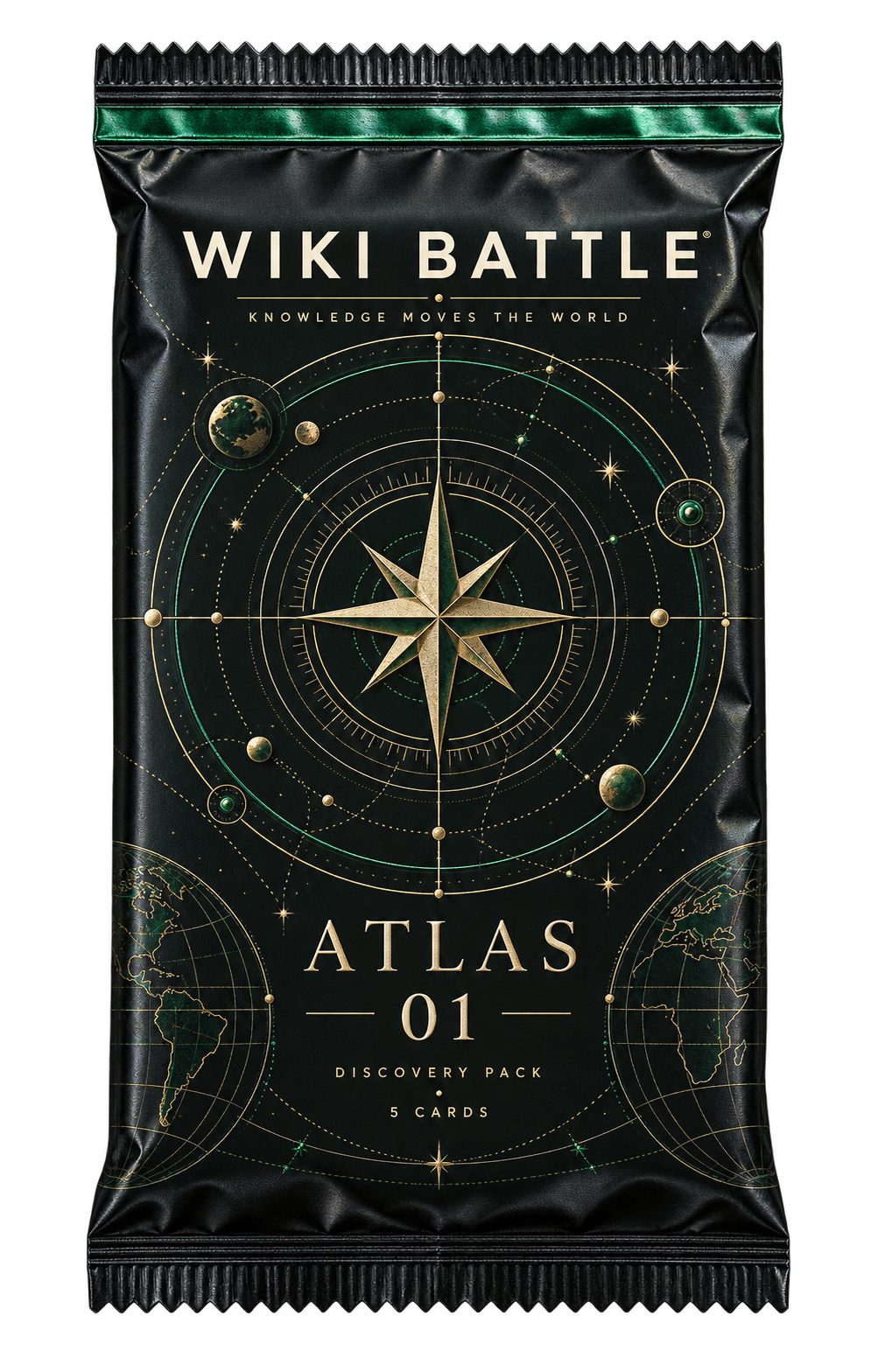
Wiki Battle is a free browser card game made from Wikipedia. Each of its 180 cards is a real encyclopedia article: a person, an artifact, a landmark, a natural wonder, an animal or an object in space. The numbers printed on a card are measured from that article, so a famous, well-sourced page makes a stronger card than an obscure stub. You open packs, keep the discoveries you like, fuse spares into rarer cards, swap and auction with other collectors, and take three-card teams into short tactical duels. There is nothing to install. The sealed pack above is the game itself, and your first 3 packs are already waiting.
What a pack contains
Every pack holds five different cards, so a single pack never repeats itself. The first four slots draw from the whole Atlas 01 pool with these odds: Common 50%, Uncommon 28%, Rare 16%, Super Rare 5%, Ultra Rare 0.9%, Legendary 0.1%. The fifth slot is the featured slot and never drops below Rare: Rare 80%, Super Rare 16%, Ultra Rare 3.5%, Legendary 0.5%. Bad luck has a ceiling. Within 10 packs you are certain to see an Ultra Rare or Legendary, and within 60 packs a Legendary. Free packs count toward both guarantees exactly like bought ones. Repeats across packs still happen, and that is what fusion and trading are for.
Serial numbers, First Editions and mutations
Every Rare, Super Rare, Ultra Rare and Legendary copy is written into the Atlas Registry the moment it leaves a pack or a fusion. It receives a serial number counted per card, so the first player to pull a given Legendary holds #0001 for good, and numbers #0001 to #0100 carry a First Edition mark. Each card also has a 3% chance to arrive mutated, roughly one pack in seven:
- Prism (2%): rainbow light runs across the whole card.
- Inverted (0.7%): the artwork is printed in negative colours.
- Gilded (0.25%): gold-leaf frame and gold ink.
- Misprint (0.05%): off-register print with doubled ink — the rarest error.
Mutations change how a card looks, never its statistics, and a mutated Common is registered too. Every registered copy has its own public page showing when it was minted, who has owned it and whether it changed hands by trade or by auction.
A daily routine that respects your time
A free pack arrives every 12 hours, and up to 2 can wait unopened, so a visit in the morning and one in the evening is enough. Coins come from play rather than from your wallet: the daily check-in gives 30, the daily quiz 40 plus a 10-coin bonus for two correct answers, and battles pay up to 100 coins a day. 500 coins buy one more pack. Coins cannot be purchased, and neither cards nor coins can be cashed out, which keeps the economy about collecting rather than speculating. Missions and the Atlas Pass track add extra rewards for opening packs, playing and winning duels, and sharing a good pull with a friend.
How a Wiki Battle duel plays out
A duel is three rounds between two teams of three cards. Each round, both players secretly choose one card and one stance. The stances form a triangle: Attack beats Feint, Feint beats Guard and Guard beats Attack, and the winning stance deals more damage while taking less. Every category leans toward one stance for a ten per cent bonus, so seeing a landmark across the table is a hint about what your opponent might do. Before the round resolves you can answer a quick two-choice knowledge question about the cards in play, and a correct answer adds twenty per cent to your hit. Teams start with seventy per cent of their average health, so knockouts really happen, and matching categories or a complete family grants a formation bonus. The AI sparring partner is always ready, and private rooms with six-character codes let you face a friend.
Fusion with a safety net
Five copies of the same rarity always fuse into one card of the next tier, all the way up to Legendary, and the result favours cards you do not own yet. Because a fusion cannot be undone, the bench protects what you are most likely to regret losing: your last copy of a card, starred favourites, cards in a saved deck and every mutated copy. Using any of them needs an explicit confirmation, and fusions of Super Rare cards or protected copies ask you to hold the button for a second. Spare copies are spent in a fixed order, unregistered ones first and then the highest serial numbers, so your lowest serials stay with you.
Trading, auctions and guilds
Every collector has a short code. Share it and friends can propose a direct swap of one card for another, choosing the exact copy, serial and mutation included. The auction house lets you list a specific copy for coins with a timed bidding window. Each listing shows its serial and mutation, so buyers know precisely which copy they are bidding on, and the registry records the sale. Guilds, friend lists, private messages and a leaderboard complete the social side. Trades and auctions use earned coins only.
Keep your collection on every device
You can start as a guest: your collection is stored on our server and linked to this browser. Signing in with Google, or with a six-digit code sent by email, keeps the same collection on your phone, tablet and laptop, and the first sign-in carries your guest progress into the new account. On a phone you can add Wiki Battle to the home screen so it opens like an app, and a simple offline page appears if the connection drops.
Three interface languages
The whole interface is available in English, French and Simplified Chinese, with card names taken from each language's own Wikipedia. Switch in Settings at any time; the choice is remembered on this device. The guides are written separately for each audience: the guide en français and the 中文指南.
Optional purchases
Nothing in the game requires payment. Players who want more packs can choose one of three one-time bundles: 10 packs for US$9.90, 22 packs for US$19.90 and 60 packs for US$49.90. The Atlas Pass · Season 1 costs US$9.90 and unlocks a premium reward track for its season. Payments are processed by Waffo Pancake or Creem as merchant of record, receipts come from them, and a purchase can be refunded within 14 days if none of its packs have been opened. Paid and free packs share the same odds.
Where the card numbers come from
Attack comes from the article's English Wikipedia page views over the last 90 days, defense from its citations and quality markers, and health from the length of its prose. Capped formulas keep the extremes in check, so a page that suddenly goes viral cannot break the balance. Each card links to the article revision it was measured from and to the licence of its image. If a number or a fact looks wrong, the correction form reaches the game operator directly.
Wiki Battle is an independent project, not affiliated with Wikipedia, the Wikimedia Foundation or WikiMasters. Article text is used under CC BY-SA, and every image keeps its own licence, listed on the image credits page.