CATEGORY TEAM
Cosmic companions
Choose any three different Space cards.
Example lineup · Any three different cards from this category count.Formation guideBrowse all 100 eligible cards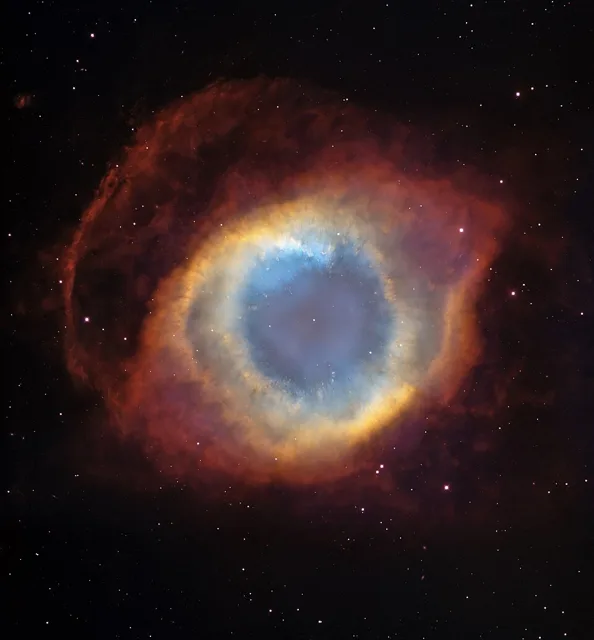 Uncommon card
The Helix Nebula is a planetary nebula located in the constellation Aquarius.
Helix Nebula is one of 100 discoveries in the space set. Find this card in a free discovery pack, or exchange 4 same-rarity duplicate cards from your collection to craft it. Fusing five Common cards always yields one Uncommon card, favouring ones you have not collected yet.
Its collectible power is 1220 and its shield is 510. Its health is 3240. These stats are derived from English Wikipedia data using capped game formulas. In battle it favours the Attack stance, like all Space cards. Daily quiz results depend on your answers.
Open a discovery packWish for this cardRead about Helix Nebula on WikipediaArticle description adapted from Wikipedia, available under CC BY-SA 4.0; shortened for the card. Revision and contributors are linked below.
Arena formations · 2 in one category: +3% ATK/DEF. Three: +6% all stats. A complete family or story: +10% all stats. Strongest bonus only.
Choose any three different Space cards.
Example lineup · Any three different cards from this category count.Formation guideBrowse all 100 eligible cardsThe Helix Nebula is a planetary nebula located in the constellation Aquarius.
English Wikipedia · 2026-07-09 – 2026-10-06. Views use Wikimedia’s “user” traffic classification, not unique visitors. Quality marker: not rated in this snapshot.
Stats use capped logarithmic scaling. Attack: 800–1,600 from daily views (cap 50,000). Defense: 200–800, weighted 80% citations (cap 300) and 20% quality marker. Health: 2,400–3,600 from prose words (cap 15,000). Values are rounded to tens. Citations indicate documentation volume, not verified truth. No rarity multiplier applies.
Snapshot wiki-2026-10-06-v1-atlas-expedition-01-daily-2026-10-10-atlas-expedition-02 · imported 2026-10-10. Live Wikipedia may have changed. Stats remain fixed until a new edition is released; an active duel keeps its starting stats.
Help us improve this discovery. Reports go to Wiki Battle, not Wikipedia.
Image: The HST data are from proposal 9700. Processed images may be obtained from the Helix MAST web site. The Hubble Helix Team includes M. Meixner, H.E. Bond, G. Chapman (STScI), Y.-H. Chu (U. Illinois, Urbana-Champaign), P. Cox (Institut d'Astrophysique Spatiale, France), W. Crothers, L.M. Frattare, R.Gilliland (STScI), M. Guerrero R. Gruendl (U. Illinois, Urbana-Champaign), F. Hamilton, (STScI), R.Hook (STScI/ESO), P. Huggins (New York Univ.), I. Jordan, C.D. Keyes, A. Koekemoer (STScI), K.Kwitter (Williams College), Z.G. Levay, P.R. McCullough, M. Mutchler, K. Noll (STScI), C.R. O'Dell (Vanderbilt University), N. Panagia, M. Reinhart, M. Robberto, K. Sahu, D. Soderblom, L. Stanghellini, C. Tyler, J. Valenti, A. Welty, R. Williams (STScI). The CTIO data were taken by C.R. O'Dell (Vanderbilt University) and L.M. Frattare (STScI). The science team includes C.R. O'Dell (Vanderbilt University), P.R. McCullough and M. Meixner (STScI). Credit : NASA, ESA, and C.R. O'Dell (Vanderbilt University) News Release Number : STScI-2004-32. Public domain. Resized and converted to WebP; cropped in card layouts. Original image and attribution.
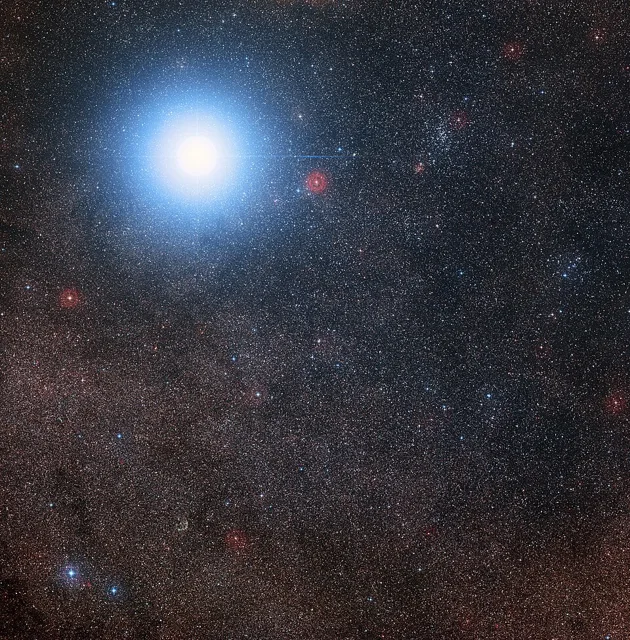 Alpha Centauri
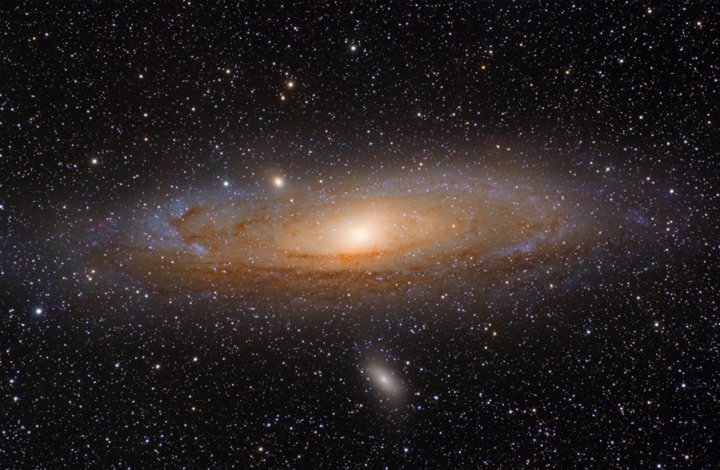 Andromeda Galaxy